
Hormone clinic SEO means building your website and Google Business Profile to capture patients searching for hormone symptoms, testosterone and estrogen treatment options, and local HRT providers. It matters more for hormone clinics than for almost any other cash-pay specialty because paid search carries real conditions for hormone therapy, including LegitScript accreditation for telehealth prescribing and certification to keyword-target prescription drug terms, which leaves organic search as the acquisition channel you control most fully.
The mistake most hormone clinics make is building their site around treatment names instead of symptoms. Your homepage says "Bioidentical Hormone Replacement Therapy" while your future patient is typing "always tired no energy male 45" into Google at 11pm. Those two things never meet, and that gap is why clinics with beautiful websites still get most of their patients from referrals.
I covered the demand side of this market in Hormone Clinic Marketing: Owning the HRT Search Surge: the search volume trends, the positioning, the full channel mix. This article is the SEO execution layer. How to structure the site, which keywords to build around, and how to rank locally when you cannot simply buy your way to the top of the page.
Key Takeaways
- Google Ads rules for hormone and testosterone therapy add certification steps, so organic search carries more of the load. Telehealth prescribers need LegitScript accreditation, and keyword-targeting prescription drug terms requires certification. Ranking organically is the channel you control either way.
- Hormone patients search symptoms first, treatments second. "Why am I so tired all the time" happens months before "TRT clinic near me." A site with only treatment pages misses the entire top of the funnel.
- Men's and women's hormone journeys need separate keyword architectures. TRT search behavior and menopause search behavior are different languages with different intent patterns.
- This is YMYL territory. Google holds hormone content to a higher evidence and authorship standard, so provider bylines, credentials, and honest claims are ranking inputs, not decoration.
- Local pack visibility converts better than blog rankings. The Google Business Profile plus a small set of city-level treatment pages usually produce the first booked consults.
Hormone Clinic SEO Services: What We Build
If you want this built and run for you, here is what our hormone clinic SEO services cover. The rest of this page explains each part, so you can judge the work whether you hire us or do it yourself.
| What we build | What it does for the clinic |
|---|---|
| Symptom and treatment pages for women's and men's hormone care | Meets patients at the search they type months before they look for a clinic |
| Google Business Profile and map ranking work | Puts the clinic in the local results where most first consults start |
| Clinician bylines, credentials and sourced claims | Meets the higher standard Google applies to health content |
| AI search visibility | Helps ChatGPT and Google's AI answers name the clinic when a patient asks who to see |
| Tracking that ties rankings to booked consults | Shows which pages produce patients, so the budget follows results |
An engineer builds it. I spent 20 years building software, including a platform that went from $0 to $500 million, and I do the technical work myself. One practice owner we work with, Dr. Diane Mueller, describes going from invisible on Google to a waiting list in her own words. Her practice is functional medicine, and a hormone clinic's results depend on its market and starting point.
Book a 30-minute strategy call and we will look at where your clinic shows up today on Google and in ChatGPT.
Why Organic Search Carries More Weight for Hormone Clinics
The short answer: your paid channel has more conditions than most specialties. Google's Healthcare and medicines policy allows U.S. telemedicine providers that are accredited by LegitScript's Healthcare Merchant Certification Program. Since October 29, 2025, Google's update page also says you must be certified in order to keyword-target prescription drug terms, although for U.S. campaigns "You may use prescription drug terms for promotional purposes, in accordance with local laws and regulations." Clinics that skip those steps can see disapprovals. Meta is similarly strict about personal health targeting.
That changes the strategic math. A med spa can lean on ads while SEO matures. For a hormone clinic, organic search plus referrals can carry much of the acquisition load while paid certification is sorted out. Every ranking you win is traffic your competitors cannot outbid you for, because in many cases they cannot bid at all.
There is a second-order effect too. Because paid carries conditions across the category, the organic results for hormone keywords are less polluted by ad-funded content farms than in other health niches. The clinics that publish genuinely useful symptom and treatment content still win these results. That window does not stay open forever in any niche, but right now the bar in most local markets is low.
If you have not read our foundational piece on healthcare SEO, it covers the base layer that everything below assumes: technical health, site structure, and the trust signals Google requires from medical sites.
How Hormone Patients Actually Search
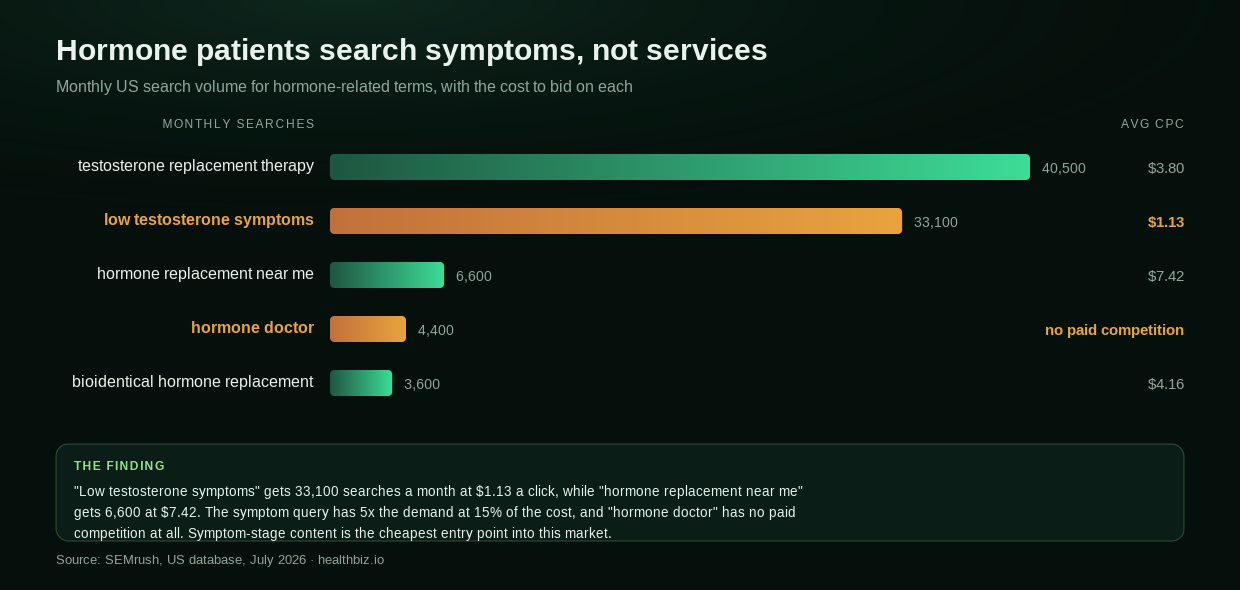
Answer first: hormone patients start with symptoms, move to self-diagnosis research, and only search for providers at the end. Your keyword strategy needs to meet them at all three stages, because the clinic that educated them at stage one has an enormous advantage at stage three.
Here is the typical progression I see in search data for this category:
| Stage | What they type | Intent | Content that captures it |
|---|---|---|---|
| Symptom | "always tired low energy men", "night sweats at 45", "brain fog and weight gain" | Confused, looking for an explanation | Symptom explainer articles |
| Self-diagnosis | "low testosterone symptoms", "perimenopause hormone levels", "signs of estrogen dominance" | Forming a hypothesis | Condition pages with lab-level detail |
| Solution research | "does TRT work", "bioidentical hormones vs synthetic", "HRT benefits and drawbacks" | Comparing options, worried about safety | Honest treatment comparison content |
| Provider | "TRT clinic near me", "hormone doctor [city]", "menopause specialist [city]" | Ready to book | Local landing pages + Google Business Profile |
Most clinic websites only build for stage four. That is maybe 10 percent of total category search volume, and it is the most competitive slice because every clinic targets it. The symptom stage has more volume, less competition, and it is where trust gets built.
One practical note on writing symptom content: use the patient's words, not clinical vocabulary. Patients do not search "hypogonadism" or "vasomotor symptoms." They search "no motivation and low sex drive" and "waking up drenched in sweat." Pull language from your intake forms and consult notes (anonymized) and from patient reviews. Our patient reviews guide covers how to mine reviews for this exact vocabulary.
Two Audiences, Two Keyword Architectures
Answer first: men researching testosterone and women researching menopause or perimenopause treatment behave like two different markets, and your site architecture should treat them that way with separate hubs, separate symptom content, and separate local pages.
Men's hormone clinic SEO: TRT search behavior
Men in this market tend to search privately, skeptically, and with heavy comparison behavior. Common patterns:
- Symptom searches framed around performance: energy, drive, gym results, libido
- Heavy "is it legit" research: "TRT pros and cons", "testosterone therapy side effects", "TRT before and after"
- Cost transparency searches: "how much does TRT cost per month"
- Modality comparisons: injections vs gels vs pellets
Build a men's hormone hub with a pillar page on low testosterone, symptom spokes, a straight-answer cost page, and a modality comparison page. The cost page deserves emphasis: almost no clinic publishes real numbers, patients desperately want them, and the page ranks because nobody else will write it. Publish your actual pricing model even if it is a range.
Women's hormone clinic SEO: menopause and perimenopause search behavior
Women's hormone searches skew toward validation and safety. Perimenopause searchers in particular often describe symptoms doctors have dismissed: "heart palpitations perimenopause", "perimenopause anxiety", "joint pain menopause." The content that wins here acknowledges the experience before explaining the physiology.
The safety question dominates the solution stage. A generation of patients absorbed the early-2000s headlines about HRT dangers, and the research picture has evolved substantially since. A careful, well-cited page walking through what the evidence actually says about HRT safety, written or reviewed by your clinician, is one of the highest-trust assets a hormone clinic can publish. Do not overcorrect into "HRT is completely safe for everyone" territory. Balanced content outranks and outconverts cheerleading in YMYL categories.
Local SEO: Where the Consults Actually Come From
Answer first: for a hormone clinic, the Google Business Profile and a small set of location-plus-treatment pages typically produce booked consults faster than any blog content, so set them up first even though the content strategy above is the long-term moat.
The local checklist, in priority order:
- Category selection. Primary category "Medical clinic" or "Wellness center" depending on your licensure and model, with relevant secondaries. There is no perfect "hormone clinic" category, so your business description and services list have to carry the specificity.
- Services list. Add every service by its patient-facing name: testosterone replacement therapy, bioidentical hormone replacement, menopause treatment, thyroid optimization, peptide therapy if you offer it. Google matches these against queries.
- Local landing pages. One page per core service per city you serve: "TRT in [city]", "Menopause treatment in [city]". Each needs unique content about that service in that location, provider details, and a booking path. Thin duplicates across cities will hurt you.
- Reviews that mention the treatment. "Dr. Smith changed my life" is nice. "After six months of TRT with Dr. Smith my energy is back" is a local ranking signal and a conversion asset. Ask for specifics when you request reviews.
- NAP consistency. Name, address, phone identical everywhere. Telehealth-hybrid clinics need to be especially careful here, because service-area settings and physical-location settings get mismatched easily.
If you run a telehealth-only or hybrid model, the local game changes: you are competing statewide rather than in a map radius, which shifts weight back toward content authority and away from proximity. Most clinics I work with are hybrid, and the right answer is to run both plays: local pages for the physical market, condition authority for the telehealth footprint.
YMYL Reality: What Google Requires From Hormone Content
Hormone therapy content sits squarely in Google's Your Money or Your Life category, which means the algorithm evaluates who wrote it and whether they should be trusted, not just whether the content is thorough. The practical requirements:
- Real authorship. Every clinical article gets a byline from your physician or NP, with a linked bio page listing credentials, licensure, and experience. "Admin" or no byline is a ranking handicap.
- Medical review on educational content. If a marketer or writer drafts it, a clinician reviews it, and the page says so.
- Citations to actual research. Link to the studies, guidelines, and society positions you reference. Never invent or embellish evidence. If the research on a therapy is mixed, say it is mixed.
- Claims discipline. "Many patients report improved energy within the first few months" is defensible. "TRT will restore your energy" is not, and it reads as marketing to both Google and patients.
This is also where honest content becomes a competitive weapon. Much of the hormone clinic category is polluted with hype. A clinic that publishes candid content about who is not a candidate, what results realistically look like, and what the monitoring protocol involves stands out immediately, to algorithms and to humans.
A 90-Day Build Order
If I were starting a hormone clinic's SEO from zero, this is the sequence:
| Phase | Weeks | Work |
|---|---|---|
| Foundation | 1-3 | Technical audit, Google Business Profile rebuild, provider bio pages, core treatment pages (TRT, women's HRT) with honest pricing |
| Local layer | 3-6 | Location-plus-service pages, review generation system with treatment-specific prompts, citation cleanup |
| Symptom content | 6-12 | Two symptom articles per week alternating men's and women's tracks, each answering one real search in plain language |
| Authority layer | ongoing | Safety and evidence deep-dives, modality comparisons, condition pages with clinician bylines |
Expect local pack movement in roughly 60 to 90 days if your profile was neglected, and meaningful organic content traffic in four to eight months depending on your market and domain history. The related walkthrough in our SEO for doctors guide covers the physician-site fundamentals that apply across specialties, and the functional medicine SEO guide is worth reading if your clinic blends hormone work with broader functional care, since the keyword universes overlap.
Questions Practitioners Actually Ask
Can I do SEO for testosterone therapy without getting flagged like my ads did? Yes. Ad policy and organic ranking are separate systems. Google does not "ban" organic hormone content; it holds it to YMYL quality standards. Write clinically accurate, well-attributed content and the advertising-policy conditions that apply to your ad account do not apply.
Should I target "hormone replacement therapy" or "bioidentical hormones"? Both, on different pages, because they attract different patients. "Bioidentical" searchers are often further along and philosophically pre-sold; plain "HRT" and "hormone therapy" searchers are broader and include insurance-minded patients. Let each page speak that audience's language.
How do I compete with the big telehealth TRT brands? Do not fight them on national terms. They cannot match you on "[city] TRT clinic," in-person labs, physician continuity, or local reviews. Own the local and trust layers where a venture-funded brand structurally cannot follow.
Is a blog really necessary if my Google Business Profile is strong? For the first few consults, no. For the next few years, yes. The profile captures patients who already decided to seek treatment. The symptom content creates those patients and builds the domain authority that keeps your local rankings defensible.
What does hormone clinic SEO cost? It depends on three things: how many locations you have, how many treatment lines need their own pages, and how strong the clinics already ranking in your city are. A single-location clinic in a quiet market needs far less work than a multi-location group in a major metro. Ask any agency for the scope behind its quote, in writing, before you compare prices.
Do you offer hormone clinic SEO services, or only the guide? Both. This guide is the full method, free to use. We also build and run it for women's and men's hormone clinics. The strategy call is where we look at your market and tell you plainly whether we can help.
The Part Nobody Wants to Hear
Hormone clinic SEO works because most of your competitors will not do it properly. They will publish four treatment pages, buy a few backlinks, and wonder why nothing happens. The clinics that win commit to symptom-first content in patient language, clinician-backed claims, and a local layer built with actual care, then keep publishing after month three when the novelty wears off.
Everything in this guide is executable in-house if you have the hours. If you would rather hand the system to a team that builds it for hormone and functional medicine practices specifically, that is what we do at Health Biz Scale. Either way, start with the Google Business Profile this week. It is the highest-leverage two hours in this entire plan.