
AI SEO for health practices is the work of getting your practice found on Google and named when a patient asks ChatGPT, Google AI Overviews or Perplexity who to see. It covers what other people call AEO (answer engine optimization) and GEO (generative engine optimization). For a practice it comes down to three things: AI can confirm who you are, it can read and quote your pages, and trusted sites say the same thing about you that you do.
None of that measures clinical skill. It measures what a machine can read, check and repeat. That is why a great practitioner can be invisible to AI while a mediocre one gets named, and it is also why the gap can be closed.
Key takeaways
- AI SEO for healthcare is SEO plus being named in AI answers. Most of the work is the same work, done with more care about consistency and proof.
- AI models answer from two places: what they learned in training and what they find in a live search. You need to be strong in both.
- Being recognized comes first. If AI can't confirm your practice's name, specialty, location and providers, nothing else you publish gets credited to you.
- Being quotable comes second. Pages that answer one patient question clearly, near the top, are the pages AI lifts into answers.
- Being corroborated comes third. Mentions on sites you don't control carry more weight than anything on your own site.
- Measure it with a fixed set of patient questions, run repeatedly, because answers change from run to run.
What we found when we asked AI about 764 practices
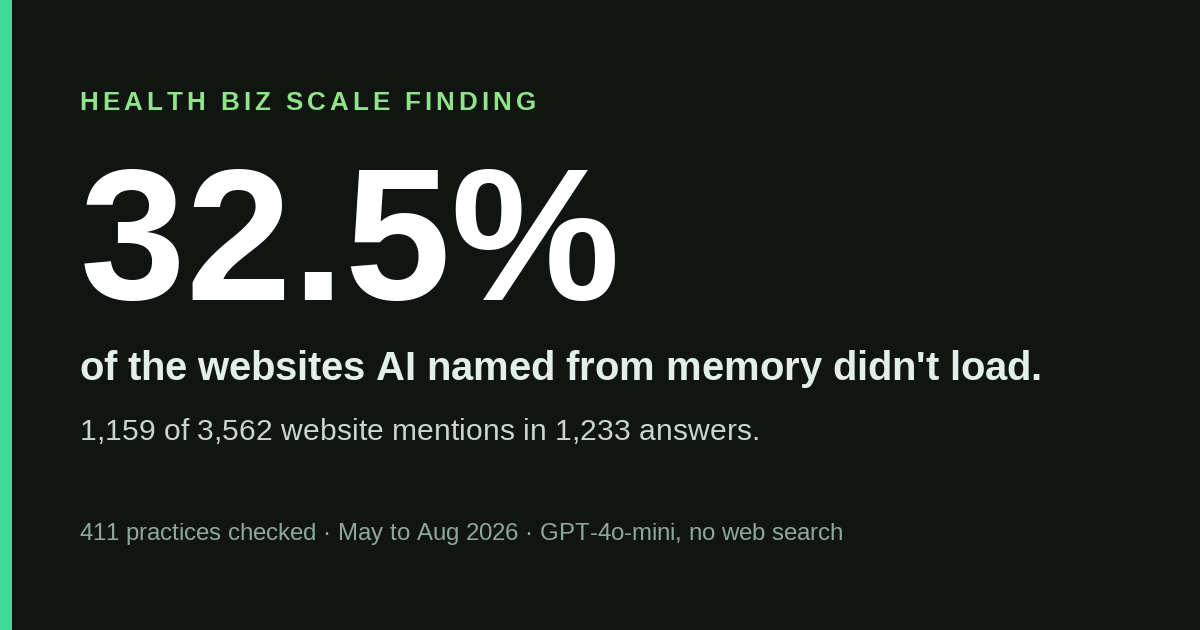
When AI answers from memory, about 1 in 3 website mentions for a patient's question point to a domain that doesn't resolve.
Health Biz Scale asked an AI model 2,292 patient-style questions about 764 health practices between May 11 and Aug 20, 2026. Only 6 of the 764 (0.8%) were named at all. In the 1,233 answers where we checked the addresses, 1,159 of 3,562 website mentions (32.5%) did not resolve. The model was GPT-4o-mini with no web search, so read this as what AI "knows" without looking, not what every patient sees today. Read the full study, method and data.
Two things follow from that. First, when an AI model has no strong, consistent signal about who is real in a local market, it fills the gap with plausible guesses. A third of the website mentions pointed nowhere, so the model was sending patients to addresses that were wrong, made up or no longer live. Second, the established practices we checked were almost absent from the model's memory. Being good at what you do and having a website did not get a practice remembered.
Live search narrows the guessing, because the model can look things up. But it looks things up in the same places: your website, your listings, the directories and the sites that mention you. The practices that get named are the ones those places describe clearly and consistently.
What AI SEO is, and the other names you'll hear
AI SEO is search engine optimization extended to AI answers. Classic SEO gets your page ranked in a list of links. AI SEO also gets your practice named inside the answer that sits above or instead of that list. People use several names for overlapping parts of the same work.
| Term | What it means for a practice |
|---|---|
| AI SEO | The umbrella: found on Google, named by AI. The term this guide uses. |
| SEO | Ranking your pages in Google's regular results and in Google Maps. |
| AEO | Answer engine optimization. Structuring pages so AI answers quote them. |
| GEO | Generative engine optimization. Shaping what AI models say about you across the whole web. |
| AI Overviews | Google's AI-written summary at the top of many search results. |
| AI Mode | Google's conversational AI search, a separate tab from regular results. |
You don't need to pick one. The work underneath is the same, and the AI SEO glossary explains each term in plain English.
How AI decides which practice to name
When a patient asks ChatGPT "who's the best functional medicine doctor near me for Hashimoto's," the answer draws on two layers.
The first is the model's memory: what it absorbed in training from the public web. That memory can be a year or more old, and it sets the model's sense of which names matter in a field. Our finding above shows how thin it is for local practices.
The second is live search. ChatGPT, Google AI Overviews, Google AI Mode and Perplexity can look things up while they answer, a process called grounding. They often split one question into several smaller searches at once: the practice's specialty, the condition, the city, reviews, credentials. Then they write one answer from what came back and, often, cite the pages they used.
That splitting step has a name, query fan-out, and it is why one well-built page per patient question matters later in this guide. So the practical question is what those searches find about you. Three studies give the best view we have, and each is correlation, not proof of cause.
- Independent links lead. SE Ranking studied 129,000 domains and 216,524 pages and found the number of separate websites linking to a domain was the strongest predictor of ChatGPT citations. Sites with up to 2,500 linking domains averaged 1.6 to 1.8 citations; sites with over 350,000 averaged 8.4. (Search Engine Journal, Nov 2025)
- Being talked about beats being linked to. Ahrefs compared 75,000 brands. YouTube mentions had the strongest correlation with AI visibility, about 0.737, consistent across ChatGPT, Google AI Mode and AI Overviews. Branded web mentions were close behind, at 0.66 to 0.71. Backlinks showed only a weak correlation. (The Next Web, May 2026)
- For practices, the sources are specific. A study of 33,340 ChatGPT citations for 200 practices across 20 metros and 10 specialties found the cited sources were mostly hospital staff rosters (27.5%), practice-owned websites (about 23%) and specialty association credentialing pages (22.1%). National directories (8.3%) and state medical board profiles (5.1%) came next. Google Business Profiles drew zero direct citations, which the study's author attributes to Google not exposing reviews as crawlable pages. (MGMA, June 2026. The study's author runs a commercial service in this field.)
Google is direct about its own AI features: "There are no additional requirements to appear in AI Overviews or AI Mode, nor other special optimizations necessary." A page has to be indexed and eligible to show a snippet in regular search. No special schema or AI text file is needed. (Google Search Central) That matters, because a lot of what is sold as AI SEO is exactly those special tricks.
Put together, the picture is consistent. AI names the practices it can verify in several places it trusts, and that are discussed beyond their own website. Your Google Business Profile still matters a great deal for Google Maps and Google's own results. For ChatGPT, your website, your provider profiles on association and board sites, and mentions elsewhere carry the load.
Check where you stand in 10 minutes
Run this before you spend a dollar. It is the same check we run before a strategy call.
- Write five patient questions. Use the words patients use, with your city: "best functional medicine doctor in Denver for thyroid," "who treats long COVID fatigue in Denver," "chiropractor for sciatica near Cherry Creek." Include your top condition and your top service.
- Ask ChatGPT in a temporary chat. A temporary chat keeps your own history from steering the answer. Ask each question. Note whether you are named, who is named instead, and which websites it cites.
- Ask Google. Search the same questions. Note whether an AI Overview appears, and which practices and pages it cites.
- Ask Perplexity. Same questions. Perplexity shows its sources clearly, which tells you where your market's answers come from.
- Run each question twice more. AI answers vary from run to run. A practice named in one run out of three is not yet recommended.
- Check your map position. Our free local rank checker shows your real Google Maps position from 49 points across your area, and who holds the spots you don't.
Write down the sites that keep getting cited for your questions. That list is your plan. It tells you which directories, associations and publications AI trusts in your specialty and city.
SETUP: how AI SEO for health practices starts
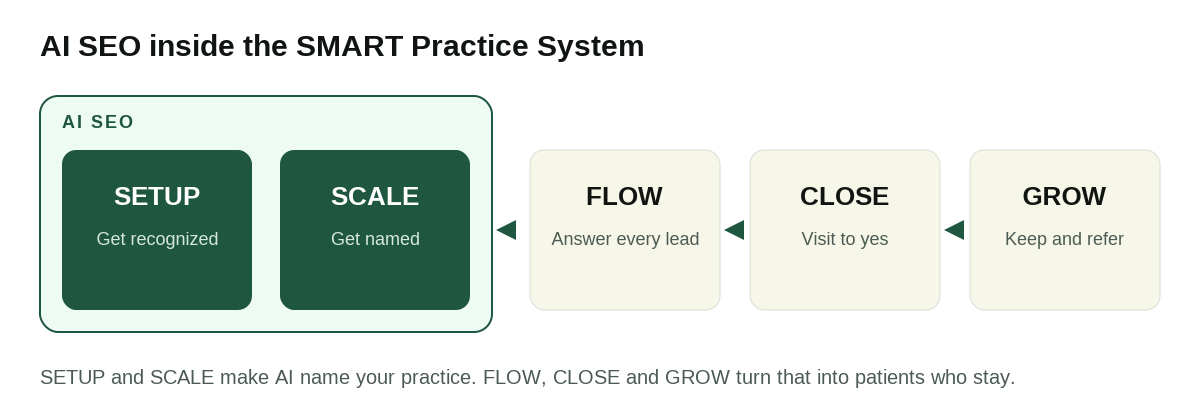
AI SEO for health practices starts with SETUP: one fact page that states who you are, listings that match it, and crawlers allowed in. We run it as the first of two stages in the SMART Practice System. SETUP makes your practice recognizable and readable. SCALE makes it quotable and corroborated, so AI names it. The last three stages, FLOW, CLOSE and GROW, turn that visibility into patients. Skip SETUP and the SCALE work is wasted. Skip FLOW and the patients AI sends you go to voicemail.
I spent 20 years engineering software, including a platform that went from $0 to $500M, before I started building patient acquisition systems for health practices. AI search behaves like the systems I used to build: it collects signals from many sources, cross-checks them, and acts on the ones that agree. Here is the whole method, in the order we run it, nothing held back.
1. Build one fact page that states who you are. Your website needs one page that says, in plain sentences, your practice's exact name, specialty, locations, providers and their credentials, the conditions you treat, the services you offer, and how to book. This is your entity home: the page search engines and AI treat as the authority on your practice. Write it so any sentence could be quoted alone.
2. Make every listing match it exactly. Your name, address and phone (NAP) must read the same on your website, Google Business Profile, Bing Places, Apple Business Connect, and health directories. One provider listed under an old address, or a practice name spelled two ways, is enough for a model to treat you as two uncertain things instead of one certain one.
3. Check the profiles AI actually reads. For practices, that means your providers' pages on specialty associations, state medical board profiles, hospital or affiliation rosters, and your public NPI registry record. Make sure each one lists the right practice, address and specialty. These are some of the most cited sources in the MGMA study, and most practices haven't checked them in years.
4. Add structured data that matches the page. Schema markup labels your page in a format machines read. Use medical schema types such as MedicalClinic for the practice and Physician for each provider, describing what the page already says. Google says no special schema is required for its AI features, so treat schema as a clarity aid, not a ranking trick. Skip FAQ markup on blog posts: Google stopped showing FAQ rich results in Search in 2026 (Google), and the same SE Ranking study found pages with it averaged fewer ChatGPT citations, 3.6 against 4.2.
5. Let the right crawlers in. Your site's robots.txt file tells bots what they may read. OpenAI runs separate bots for separate jobs: OAI-SearchBot surfaces sites in ChatGPT search, GPTBot collects training data, and each setting is independent (OpenAI). Blocking GPTBot is a choice about training. Blocking OAI-SearchBot keeps your pages out of ChatGPT search answers. Check yours, because some services now block AI bots by default; Cloudflare switched its default to block AI crawlers in July 2025 (Cloudflare). See AI bot blocking.
SCALE: making AI name your practice
SCALE is the second stage: once AI can confirm who you are, you give it pages worth quoting and other sites that vouch for you.
6. Write one page per patient question. The pages AI quotes answer a single question clearly in the first two or three sentences, then explain. That is answer-first writing. Build pages for the questions from your 10-minute check: each condition you treat, each service, what a first visit involves, and what it costs. Cost and what-to-expect pages are the ones most practices skip, and they are what patients ask AI.
7. Put a real clinician's name on clinical pages. Health is a topic Google calls YMYL, "your money or your life," and holds to a higher standard of E-E-A-T: experience, expertise, authoritativeness and trust. A named provider with a bio, credentials and a link to their profiles is evidence a machine can check. An unsigned page is a claim it can't.
8. Make sentences worth quoting. A quotable sentence stands on its own, contains a specific fact, and names the subject instead of saying "it." "Our Denver clinic tests for SIBO with a three-hour breath test before starting treatment" can be lifted into an answer. "We take a whole-person approach" can't. Specific facts per sentence is what separates the two.
9. Earn mentions where AI looks. This is where most of the weight sits, based on the studies above. Get listed and described accurately on the directories and associations that came up in your check. Get into local "best of" and "top doctors" features. Appear on podcasts and in local news as the expert on your condition. Publish short videos with your practice name in the title and description, since YouTube mentions had the strongest correlation in the Ahrefs study. Ask happy patients for reviews and answer them.
10. Give AI one number nobody else has. Original facts give other sites and AI a reason to cite you, because they can't find them anywhere else. Track something real in your practice, anonymize it, and publish it with the method. A line other sites can quote looks like this: "Of [number] new patients with [symptom] we saw in [year], [percent] had [finding]." Use only numbers you can defend.
What happens after AI names your practice
That is where FLOW, CLOSE and GROW come in. AI visibility only matters if the patient becomes a patient. When AI names you, the patient calls, fills out a form or books. If the call hits voicemail during a visit, they ask AI again and call the next name. FLOW answers every inquiry within minutes, day or night. CLOSE makes sure the patient arrives at the consult already understanding your approach. GROW keeps them and turns them into referrals, which in turn become the reviews and mentions that feed SCALE. Our AI systems page covers how we build that side.
Healthcare rules that change AI SEO
Health practices play by stricter rules than other businesses, and AI SEO has to respect them. This is general information, not legal or medical advice.
- Claims. The FTC expects health claims to be backed by competent and reliable scientific evidence (FTC Health Products Compliance Guidance). Anything that sounds like a promise of an outcome can create problems with the FTC and your state board, and it gives AI nothing it can verify. Describe what you do and who you help, say "may help" where the evidence supports it, and cite it.
- Patient privacy. Keep patient information out of website tracking and ad pixels; HHS has issued guidance on tracking technologies for HIPAA-regulated practices, part of which a federal court limited in 2024 (HHS). Any outside tool that handles patient information for you needs a Business Associate Agreement under HIPAA (HHS). Consumer AI chatbots don't offer one, so staff should not paste patient notes into them.
- Reviews and testimonials. Ask for reviews only in ways your board allows, use testimonials only with consent, and don't confirm someone is a patient when replying to a review.
Accurate, specific, attributed content is what regulators expect, and it is also the kind of content AI can verify.
How to measure AI SEO
Measure it the way you'd measure anything that varies: a fixed test, repeated.
- Prompt tracking. Keep the same set of 15 to 25 patient questions. Run each one several times a month in ChatGPT (temporary chat), Google and Perplexity. Record whether you're named and who is named instead. Keep the questions fixed, or you're changing the test instead of measuring progress.
- AI share of voice. Of all the times AI names a practice for your questions, how often is it you?
- Citation share. How often your website is one of the cited sources.
- ChatGPT referral traffic. Visits that arrive from chatgpt.com, which your analytics can separate out.
- Booked first visits. The only number that pays the bills. Ask every new patient how they found you, and add "ChatGPT or another AI" as an option.
How long AI SEO takes
In our experience, AI SEO for a practice takes six to nine months to compound, with the first fixes going live in two to eight weeks. Listing and directory fixes go live as each site approves them. New pages are usually picked up by Google and Bing within one to four weeks. Movement in AI answers follows once those sources update. Anyone promising you'll be "ranked in ChatGPT" in a few days is selling a screenshot, and AI answers change from run to run, which is why the 10-minute check asks every question three times.
Where practices go wrong
Most AI SEO mistakes come from chasing shortcuts or measuring the wrong thing.
- Buying the trick instead of the work. An llms.txt file, a special schema plugin or an "AI-optimized" page template won't make AI name you. Google says no special files or markup are needed for its AI features. See llms.txt.
- Blocking the bots that would cite them. A security setting that blocks every AI crawler can keep you out of ChatGPT and Perplexity answers, even while Google still sees you.
- Writing about everything at once. One page that covers twelve conditions answers none of them well enough to quote.
- Ignoring the profiles they don't own. Association pages, board profiles and directories outweigh most of what you can publish yourself, and they are often out of date.
- Measuring with one screenshot. Answers vary. Track a fixed set of questions over time, or you'll chase noise.
- Treating AI as separate from SEO. AI search often draws on the same pages search engines already rank, so the two grow together.
Questions practice owners ask
Is AI SEO for doctors different from regular SEO?
It builds on it. Regular SEO ranks your pages in Google's list of results and in Google Maps. AI SEO adds being named inside AI-written answers, which depends more on consistency across the web and on mentions from sites you don't control.
Do patients really use ChatGPT to find a doctor?
Some do already, and the AI answers at the top of Google reach patients who don't use ChatGPT at all. You can see whether it matters in your market by running the 10-minute check above and looking at your analytics for visits from chatgpt.com.
Do I need an llms.txt file?
No file is required. Google says it needs no special files or markup for AI Overviews or AI Mode. An llms.txt file does no harm, but it is not why practices get named.
What's the difference between AEO and GEO?
AEO is about your own pages being quoted in AI answers. GEO is about what AI models say about you across the whole web, including sites you don't control. Both are part of AI SEO.
How do I check if ChatGPT recommends my practice?
Ask it five real patient questions with your city, in a temporary chat, three times each, and note who it names and which sites it cites. The 10-minute check above walks through every step, including Google and Perplexity.
Does schema help AI Overviews?
Google says no special schema is needed to appear in AI Overviews or AI Mode. Schema such as MedicalClinic and Physician still helps machines read your page clearly, so add it where it matches what the page says.
Is AI SEO HIPAA compliant?
It can be. AI SEO works with public information about your practice, not patient records. Keep patient information out of tracking pixels and AI tools, and get a Business Associate Agreement from any vendor that handles it.
Can I do this myself?
Yes. Every step is on this page, and each linked guide goes deeper. Practices hire us when they would rather have it built and run, measured against booked visits, than learn it themselves.
Go deeper
Each guide below takes one part of this method further, and the AI SEO glossary explains every term in plain English. If you want it built for your practice, see how we run AI SEO for practices.
This guide is general information, not legal or medical advice.